
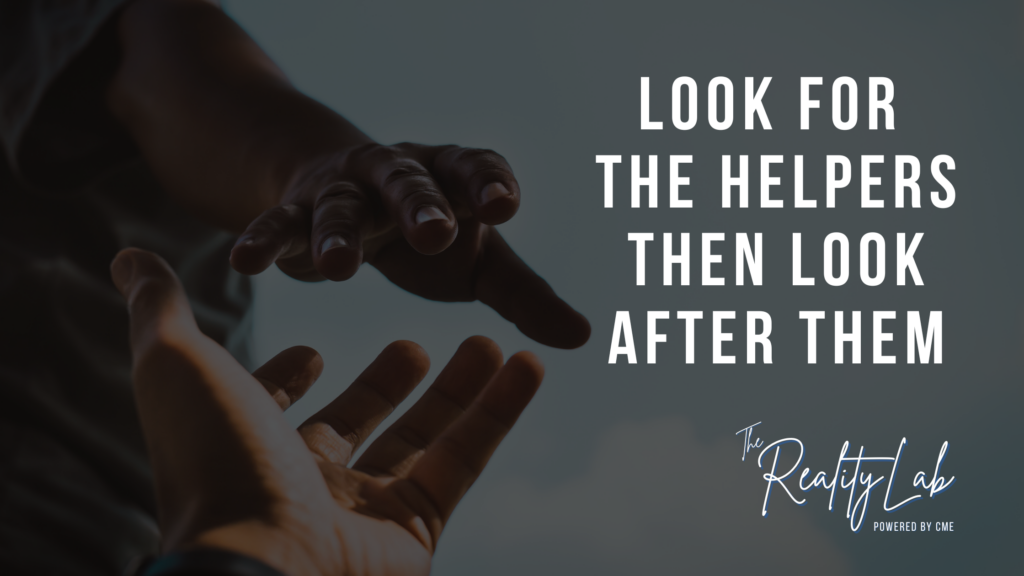
Many of us know the Mr. Rogers quote. When something frightening showed up on the news, his mother would tell him to look for the helpers. You will always find people who are helping.
It is a beautiful reminder. It is also incomplete for the moment we are living in now.
Because today, the helpers are still there. Nurses. Teachers. Social workers. School administrators. First responders. Nonprofit professionals. Faith leaders. Community volunteers. They are still showing up. Still carrying responsibility. Still absorbing complexity and pain that most people never see.
And somehow, we keep acting surprised when they burn out.
Many of those helpers are quietly struggling. And many of them are leaving. Not in dramatic exits. In exhausted ones.
That is not because they stopped caring. It is because caring, unsupported and underfunded, is not a renewable resource.
Burnout has become one of the most misunderstood words in our public conversation. We tend to treat it as an individual problem. A lack of resilience. A personal weakness. A failure to manage stress. Usually with a well meaning suggestion to take a walk or try a new productivity app.
That framing is not only inaccurate. It is convenient.
Burnout is not about effort or commitment. The people most affected are often the most dedicated. Burnout is chronic exhaustion. Emotional overload. A slow erosion of sustainability over time. High functioning does not equal well being. People can perform, lead, and serve while quietly burning out and receiving praise for their dedication.
I see this constantly in my work and in my research.
Helpers are very good at pushing through. They normalize overload. They absorb stress quietly. They delay asking for help because someone else always seems to need it more. By the time they leave, they are often already depleted. That is why departures feel sudden to organizations and communities. The warning signs were there. They were just inconvenient.
This is not an individual failure. It is a systems issue.
When helpers burn out, services become unstable. Institutional knowledge walks out the door. Turnover drives up costs. Communities lose trusted relationships. We call it unfortunate. Then we replace them and hope for the best.
Research across helping professions is remarkably consistent. Workload alone does not cause burnout. Meaningful work does not protect against burnout. Passion does not offset poor systems. Caring harder is not a strategy.
What does matter is support.
Quality supervision and leadership. Clear expectations. Realistic staffing. Feeling seen, resourced, and backed. One of the strongest protective factors we know is not individual grit. It is relational and structural support. Which is far less inspirational on a poster, but much more effective.
This is where communities come in.
We often fund programs and celebrate outcomes without asking what it costs to sustain the people delivering them. We reward sacrifice without examining whether it is necessary, ethical, or quietly destructive. We are surprised when helpers leave, even though the conditions that drive burnout have been normalized, budgeted, and sometimes applauded.
The goal is not doing more. The goal is doing good work without breaking people. This should not be controversial.
Organizations cannot solve this alone. Communities cannot treat this as an internal HR issue and move on. Helpers depend on communities just as much as communities depend on helpers. This is a shared responsibility, whether or not it fits neatly into a grant report.
This is why groups with a focus on building better communities matter so deeply in this conversation. For our community, this looks like Rotary Groups.
Groups that are uniquely positioned to ask better questions. Not just what impact is being made, but how that impact is being sustained. Not just whether a program is effective, but whether the people running it are supported. Not just what outcomes were achieved, but at what human cost.
A simple question can change the entire conversation.
How are the helpers being supported?
Mr. Rogers taught us to look for the helpers. In this moment, we must also look after them. We must design systems that sustain them. We must ensure that helping remains a calling, not a cost.
Strong communities depend on healthy helpers. That is not sentimental. It is structural.
And it is work worth doing. Even if it is less comfortable than clapping for heroes and moving on.