

Part 2: From Toxic to Trusted
How leadership missteps erode trust and silence real impact
Trust & Influence Series | Part 2 of 3
We talk a lot about leadership. We praise boldness, celebrate vision, and follow authority. But what happens when leadership looks good on paper – yet trust quietly drains from the room?
In helping professions, nonprofit organizations, and mission-driven spaces, toxic leadership doesn’t always wear a villain’s mask. Sometimes, it shows up as over-functioning. As martyrdom. As control disguised as care. And even the most well-intentioned leaders can find themselves replicating the very systems they once promised to disrupt.
As I continue my research into burnout among nonprofit leaders and social workers, one thing is clear: burnout is rarely about just “working too hard.” It’s about misaligned leadership, emotional labor without support, and environments where trust is quietly corroded.
The Slow Erosion of Trust
Trust isn’t usually shattered in one dramatic moment. It fades in minor, repeated missteps:
- Saying one thing, doing another
- Changing expectations based on who’s in the room
- Promoting self-care in theory, while rewarding exhaustion in practice
- Taking credit for the team’s work but dodging responsibility when things go wrong
- Silencing dissent with the language of “protecting the culture”
This is what toxic leadership often looks like. Not loud, but insidious. Not obviously cruel, but consistently disorienting.
It’s not always about power abuse. Sometimes it’s about fear-based control, perfectionism, or a lack of self-awareness. But the result is the same: people stop trusting, and the most capable among them begin to leave.
Well-Meaning, Still Harmful
Let’s be honest: many toxic environments are not built by villains. They’re built by exhausted, overextended, unsupported leaders doing what they think is best.
- The nonprofit executive who micromanages because they fear scrutiny from funders.
- The manager who avoids hard conversations because they don’t feel equipped.
- The founder who confuses loyalty with silence.
- The program director who models burnout is likely doing so because that’s what was modeled for them.
These are not bad people. But trust isn’t about intent, it’s about impact.
Sometimes, even trusted leadership models like servant leadership can unintentionally turn toxic when overused or misapplied. As I explored in “When Service Becomes Self-Sacrifice,” servant leadership often rewards over-functioning and emotional depletion, celebrating burnout as a sign of commitment and confusing self-erasure with genuine service. Without boundaries and structural awareness, trust can quietly turn into exploitation.
Burnout as a Signal, NOT a Symptom
In high-turnover environments, we often focus on wellness strategies. But before we talk yoga, let’s talk about why people don’t feel safe to rest in the first place.
Burnout doesn’t just mean “you’re tired.” It means:
- You don’t trust your organization to support you
- You don’t feel safe to be honest about limits
- You’ve lost a sense of meaning in the mission
- These are trust problems, not individual resilience issues.
Sidebar: Toxic Traits vs. Trusted Practices
Recognizing the shift from control to connection.
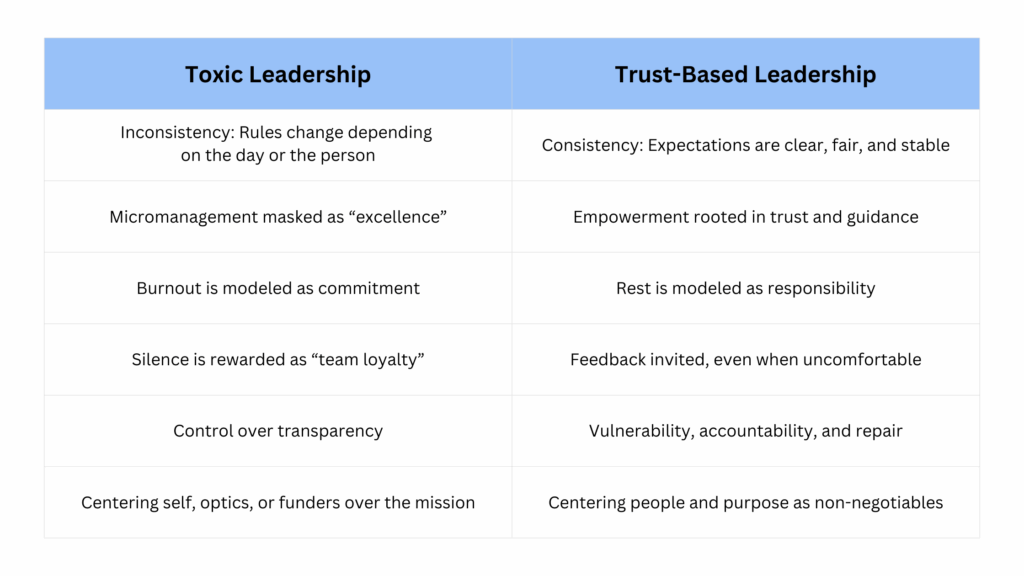
Reflection Prompt:
Which side of this chart have you experienced most often? Which one do you model, and what needs to shift?
What Toxic Cultures Cost
When trust erodes, here’s what organizations actually lose:
- High-performing, mission-driven talent
- Creativity and innovation
- Willingness to give feedback
- Psychological safety
- Long-term sustainability
What remains? Fear, compliance, performative alignment, and chronic turnover.
And often, the people most likely to leave are those the mission needs most: empathetic, value-driven, solution-oriented changemakers. They don’t quit because they don’t care. They quit because they care too much to stay in a system that drains them of their energy.
From Toxic to Trusted: What’s the Shift?
There’s a better way. And it doesn’t require perfection; it requires humility, clarity, and a return to trust.
Trust-based leaders:
- Lead consistently, not reactively
- Welcome challenge and feedback
- Create room for rest, reflection, and humanity
- Own mistakes and repair harm
- Set a tone that centers people, not performance optics
They know that their real legacy is not what they accomplished under pressure; it’s how they made people feel in the process. And trust is what makes those efforts stick.
A Personal Reflection
I’ve worked with, consulted for, and mentored dozens of organizations over the past two decades. I’ve seen toxic leadership destroy brilliant teams. I’ve also seen what happens when someone gets brave enough to change the tone: when they stop over-functioning, start listening, and give themselves (and others) permission to lead differently.
It’s not always easy. But it’s possible. And it’s necessary.
Closing Thought: What Are You Replicating?
The most challenging question I’ve had to ask myself – and one I invite you to ask too – is this:
Are you replicating the leadership culture that hurt you?
It’s easy to pass down what we learned, especially when we never had the chance to pause and question it. But leadership rooted in trust begins when we stop performing and start examining. When we lead out of purpose, not pressure.
Next in the Trust & Influence Series: Part 3 – The Quiet Power of Trust
We’ll explore what trust-based leadership looks like and how influence built on trust becomes your most enduring legacy.